18. Februar 2026
Brands Update - February 2026 – 4 von 8 Insights
In case you missed it - 2025: designs
EU cases
Grace period relevant to individual character as well as novelty: Lidl v EUIPO – Liquidleds Lighting (LED light bulbs), General Court
Lidl sought to invalidate Liquidleds' 2017 Registered Community Design (RCD) for LED light bulbs (shown below). It relied on two earlier designs that it said Liquidled had disclosed to the public and produced the same overall impression as the design in question. Both the Invalidity Division and Board of Appeal dismissed the invalidity application: one of the prior designs had been disclosed by Liquidled during the grace period so did not need to be taken into account and the other design had not been disclosed to the public at all.
The Court rejected Lidl's argument that the grace period requires identity of design (ie is only relevant to novelty) and emphasised that the grace period seeks to protect designers' interests and encourage innovation. Requiring identity would undermine these aims by preventing designers from making necessary adjustments to a design based on market testing results before registration.
Lidl also argued that the EUIPO had misapplied the burden of proof. The General Court disagreed, confirming that the invalidity applicant must prove disclosure of a prior design whereas the design owner invoking the grace period must prove that the conditions for the application of the grace period are present. Here, the Board correctly examined both parties' evidence and did not reverse the burden of proof.

What this means for you: Unsurprisingly, the Court confirmed that the grace period shields not only identical self-disclosures but also self-disclosures producing the same overall impression when individual character is at issue. Designers can test the market or exhibit prototypes within the 12-month window without jeopardising registration, provided they can prove the disclosure was their own.
Prior disclosures must identify all relevant aspects of the design to be novelty destroying: Hamster Polska v EUIPO, General Court
The General Court has upheld the EUIPO's decision that an RCD for chemical public toilets was novel, despite the existence of an earlier disclosed design showing a similar toilet structure.
To prove disclosure of the prior design, the invalidity applicant submitted various evidence, including photographs allegedly taken at a Warsaw trade fair in October 2008, website extracts, and an email with attached images. The Board of Appeal rejected most of this evidence as lacking probative value: photographs without dates or source information and email attachments too small to discern could not establish disclosure.
The Board did accept that two pieces of evidence – a Wikipedia extract from 2 December 2008 and a notarised website archive from 19 December 2008 – established disclosure of the earlier design but found that the design disclosed was not identical to the RCD. The earlier design did not show the right-hand side of the toilet (which revealed an additional door and opening in the contested design) and showed the door closed rather than open.
The General Court agreed, emphasising that disclosure cannot be demonstrated by probabilities or presumptions but must be based on solid and objective evidence. Where a contested design contains features not present or identifiable in the earlier design, the designs cannot be regarded as identical.
What this mean for you: parties seeking to invalidate designs based on prior disclosure need to ensure that their evidence is comprehensive, shows all relevant aspects of the design, and is properly dated and clearly sourced. Partial views of earlier designs may be insufficient to establish lack of novelty where the contested design reveals additional features. They may, however, be relevant for assessing individual character.
High design freedom limits individual character: Deluxe Holding v EUIPO – Piffany Copenhagen (electric candles), General Court
Piffany sought invalidity of an RCD for electric candles (depicted on the left below), invoking lack of individual character and relying on two prior candle designs (both depicted on the right below). The Invalidity Division had annulled the RCD for lack of individual character versus one of the prior designs. The Board of Appeal came to the same conclusion but focused on the other prior design.
The General Court dismissed an appeal by the owner of the RCD. Key findings included that:
- The Board was entitled to re-examine the entire dispute and start from a different prior design.
- Individual character turns on the informed user's overall impression of the designs, factoring in the degree of design freedom. The latter was high for electric candles. The designer's freedom was limited only by the requirement that electric candles be equipped with an electrical source enabling them to light up, there being scope for variations in shape, colour and material. Where a designer has high creative freedom, the more significant the differences must be to achieve individual character over existing designs.
- Common features - an elongated white cylinder and teardrop flame connected to a thin black wick - dominated both designs. The only difference between the designs - a circular depression with resin disc in the contested design versus a flat upper part in the prior design - was of secondary importance. This difference would be detected by the informed user only after close examination of the candles, "going beyond the concept of 'overall impression'".
- The commercial success of a feature is irrelevant when assessing whether it would be detected by the informed user; the overall impression of a design is that produced by the design as registered.
- Even assuming market saturation (which would mean that small differences in designs would be more likely to be noticed), the small difference in the upper part of the candle did not change the similar overall impressions produced by the designs.
What this means for you: it is perfectly acceptable for the Board of Appeal to re-examine the entire dispute and come to the same or different conclusions based on a different prior design raised. Where the degree of design freedom is high, the design in question must depart more significantly from the prior design corpus to have individual character. However, only differences that would be detected by the informed user are relevant. Market success or alleged innovativeness of a feature does not mean that such feature would be noticed or confer a different overall impression.
 |
 |
 |
Evidence of market saturation must relate to the priority/filing date of the design: EveMotion v EUIPO – WMK Trading (Pavilion), General Court
An RCD for a pavilion was attacked for lack of individual character. The Board and General Court applied the four-step test for assessing individual character: sector, informed user, design freedom, overall impression.
The Court held that the degree of freedom of the designer was high because pavilions could take all basic shapes imaginable (round, oval, rectangular, pentagonal) and did not necessarily have to include movable side walls. There were no legal requirements limiting freedom. The Court rejected arguments that technical necessities linked to inserting lighting limited design freedom. It also rejected the argument that saturation of the design corpus limited design freedom, noting that evidence of saturation must relate to the filing/priority date of the design in question and that later internet searches were not probative.
Comparing registered views only, common features between the prior design and the design in question (six supports, similar frame, integrated sides, double roof) outweighed minor differences in frame structure, curtain colour and LED string, which were secondary and not dominant. The fact that a national court had found differently was irrelevant. National interim findings did not bind EU bodies. The General Court upheld the finding of lack of individual character and rejected the appeal.
What this means for you: where design freedom is high, only pronounced differences will shift the informed user's overall impression. Evidence of market saturation must relate to the priority/filing date of the design in question. Where the market is saturated, small differences between a design and the design corpus are more likely to be noticed by the informed user (such that those differences are sufficient to confer individual character).
Designs can be refused registration based on prior trade marks: Eti Gıda Sanayi ve Ticaretv EUIPO – Star Foods, General Court
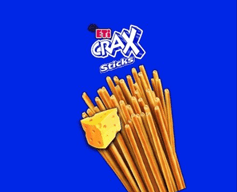
In three parallel invalidity proceedings, the General Court has dismissed appeals by Turkish snack manufacturer Eti and upheld the EUIPO's decisions declaring three of its RCDs invalid (one such RCD depicted on the left below). The three RCDs depicted packaging for cheese-flavoured snack sticks featuring the word element 'CRAX' (or variations thereof) prominently displayed alongside Eti's branding. The case is interesting because the designs were held invalid on the basis that they were in conflict with Star Foods earlier Romanian figurative trade mark registration for KRAX, registered for cereal-based snack products (depicted on the right below).
The Board of Appeal found a likelihood of confusion, concluding that the goods were complementary and therefore similar. The General Court agreed that 'KRAX' and 'CRAX' were the most distinctive and dominant elements in the designs/marks, with all other components playing secondary roles. Visually, the signs were similar to an average degree, as three out of four letters coincided in the sequence 'R-A-X', all depicted in stylised upper-case letters with a similar three-dimensional effect. Phonetically, the Court found a high (or average) degree of similarity, noting that consumers tend to abbreviate marks orally and would likely pronounce only the dominant 'CRAX' element. Whilst the signs were conceptually different due to descriptive elements, this did not outweigh the visual and phonetic similarities.
What this mean for you: design owners need to be careful when incorporating word elements into their designs that are similar to earlier trade marks, even where the designs contain additional distinctive elements.
 |
 |
Informed user is the same for modular systems as other designs: LEGO A/S v Pozitív Energiaforrás, ECJ
This reference for a preliminary ruling from the ECJ concerned modular systems (designs allowing multiple assembly or connection of mutually interchangeable products), the nature of the informed user, and sanctions for infringement. The case involved LEGO's RCDs for coupling components of toy building sets: modular systems in which plastic building blocks can be easily put together and taken apart (an example of which is below). The ECJ ruled that:
- The same informed user standard applies to designs protected as modular systems as for other designs. Overall impression is assessed by reference to an informed user who, without being a designer or a technical expert, knows the various designs which exist in the sector concerned, possesses a certain degree of knowledge with regard to the features which those designs normally include and, as a result of their interest in the products concerned, shows a relatively high level of attention when he or she uses them as components of the modular system of which they form part, and not by reference to a user who, possessing technical knowledge similar to that which may be expected of a sectoral expert, examines the design concerned down to the smallest detail and whose overall impression is based primarily on technical considerations.
- Connection features protected as modular systems are considered as part of the assessment of overall impression. Design law is not only concerned with enabling the overall appearance of products to vary. It is also concerned with enabling innovation in connection points (for modular systems) that produce a different overall impression on the informed user.
- The Design Regulation provides that, where there is a finding of infringement, the court will make various orders (eg an order prohibiting the act complained of) unless there are 'special reasons' for not doing so. The ECJ ruled that the concept of ‘special reasons’ does not apply where an infringement relates only to some of the pieces of a modular system, the number of which is small in relation to the total number of components of that system.
What this means for you: the informed user standard is uniform. Modular system interconnection features can count in the overall impression analysis and can tip infringement. Special reasons is interpreted relatively narrowly.

UK cases
Invalidity counterclaim precluded on basis of res judicata: Praesidiad Holding v Zaun Ltd, Court of Appeal
The Court of Appeal has held that a defendant to infringement proceedings in the UK was precluded from counterclaiming for invalidity of an RCD and the corresponding re-registered UK design (UKRRD) asserted against it because it had already unsuccessfully challenged the validity of the RCD before the EUIPO and on appeal to the General Court. (The infringement action had been commenced in the UK before the end of the Brexit transition period hence why the RCD had been asserted.)
The Brexit Withdrawal Agreement precluded the counterclaim for invalidity of the RCD and was a matter of jurisdiction. The principles of res judicata and abuse of process precluded the re-litigation of the validity of the UKRRD. The UKRRD was, in substance, the same as the RCD albeit a distinct legal right. The grounds of invalidity raised were largely the same (albeit there were some differences as to the prior designs cited and arguments on functionality).
What this means for you: this decision is quite narrow on its facts, relating to UKRRDs where the parent RCD has already been challenged.
Minor discrepancies in design views can sometimes be tolerated: Safestand v Weston, Court of Appeal
This case concerns the validity of three UK re-registered designs (UKRRDs) for builders' trestles – a modular product. The UKRRD had been held invalid at first instance by the High Court on the grounds that (a) they did not depict the design of a single product and (b) they lacked clarity (not being clearly for a single product). This was because: (i) some components of the design were coloured differently in different images and (ii) some components were not present in particular images.
The Court of Appeal overturned the High Court's findings and ruled that all three UKRRDs were valid. Key findings were that:
- A complex product (with parts mechanically connected) can be a single product, as can a set of articles (such as a chess board and pieces). However, different embodiments of the same design concept are not a single product.
- The fact that some components were missing in some images of the designs reflected the fact that the product was modular and so could be assembled in different ways, with some parts being optional.
- The fact that different colours were used across images of the designs did not mean that there were alternative embodiments. It was clear that both colours were present in the product (eg in the "total" product, there might be one red bracket and one green bracket).
- Minor discrepancies (including of colour) between different views in a registered design do not invalidate it, provided the views can be reconciled to represent a unitary design.
- It is permissible for the Court to have regard to trestles manufactured to the UKRRDs by the design owner at least for the purpose of confirming conclusions drawn from the images (applying the UK Court of Appeal decision in the M&S v Aldi case).
- It is not clear whether lack of clarity of itself is a ground for invalidity of a registered design. The judge did not consider the UKRRDs lacked clarity so did not need to decide the point.
What this means for you: to avoid debates about validity, make sure that the design is represented consistently across views and any optional or interchangeable elements are clearly marked. While minor discrepancies may be tolerated, it is best to avoid the debate. Careful drafting allows a single registration to cover modular systems with interchangeable or optional components.
Concealed features and how a design looks on a particular shaped person are irrelevant for design right: Edwards v boohoo, High Court
Edwards brought an infringement claim against boohoo relating to unregistered design right in the shape and configuration of various clothing items. The court found no infringement as boohoo had not copied any of the claimant's designs.
- The court cautioned against defining designs in general terms and implied this could be avoided by drawing up a design document specifying dimensions and other original features. Here, that had not been done and so the prior designs were "recorded" in the clothing items themselves. The court noted that, whilst this approach can make it easier to establish infringement by defining the design in general terms, it also makes it easier for defendants to argue that the design is a method or principle of construction, is commonplace, or does not attract protection as it is simply a generalised idea.
- The court ruled that features that cannot be seen (such as concealed waistbands) or which are not present (lack of seams and zips) cannot form part of protection for design right.
- The court rejected the claimant's argument that a design's shape and configuration when worn is relevant, noting that design right must be clear and cannot vary when worn or according to who is wearing it.
- On infringement, the judge observed that it is unsurprising that some allegedly infringing articles resembled previous designs given the enormous number of clothing items produced each week and the limited ways to design clothing to fit the human body. The likelihood of a high-profile company using the claimant's social media feed with few followers for design inspiration was low; and the abstract way the claimant described her designs simply increased the chance they might resemble independently designed garments.
What this means for you: define designs with specificity (preferably in a design document) where possible. Remember that concealed features and how a design looks on a particular shaped person are likely to be irrelevant for design right. To infringe design right, the claimant must show that there was copying. That allegation has to be credible.
High Court provides guidance on UK unregistered design right exclusions and infringement in safety decking dispute: J Mac Safety Systems v Q Deck Safety Systems, High Court
In this case, the Patents Court delivered an important judgment on the validity and infringement of UK unregistered design right in safety decking panels and pins. On validity, the Court held that:
- For design right to subsist, the design in question must be original (in the same way that a work must be original for copyright to subsist). The court had to consider whether the UK's old test for originality (skill, labour and judgment) continued to apply or whether the ECJ's 'new' test (author's own intellectual creation) now applied. While the parties did not argue the point deeply in their submissions, the court saw no reason to depart from the ECJ's test, which the Court of Appeal has confirmed applies to copyright. There was no reason to think that the definition of 'originality' should be different for design right compared to copyright.
- Section 213 of the CDPA provides that a design is not original if it is "commonplace" in the design field in question at the time of its creation. It is generally considered that showing that a design is commonplace is a high bar to cross. The court commented that a single piece of non-obscure prior art can render a design commonplace, but new combinations of run-of-the-mill features may not be commonplace.
- Section 213 also excludes from being considered a design right features of shape or configuration of an article which enable the article to be connected to, or placed in, around or against, another article so that either may perform its function. The court commented that this exclusion requires precision in the interrelationship between articles; transient, imprecise human interactions (such as hand holds) will not usually be excluded from deign right protection.
- Section 213 also excludes "surface decoration" from constituting design right. However, this exclusion applies only to decorative surface-only features; truly three-dimensional features are not excluded merely because they add visual effect.
On infringement, the Court applied the two-stage test under section 226 of the CDPA: determine (1) if there was copying, and (2) whether the article made by the alleged infringer was made "exactly or substantially to that design". The court held that:
- Excluded features must be disregarded in the comparison, but commonplace features remain part of the overall design assessment (since it is only if the design as a whole is commonplace that it is deprived of design right protection).
- Despite the defendant having started from the claimant's system when designing and internal communications acknowledging the designs looked "exactly the same", the Court found that the Q Deck 1x1 panel did not infringe the claimant's standard panel design because the overall appearance of the final product differed sufficiently. However, the same panel was found to infringe the claimant's design right in its perimeter design, as the differences were minor.
The case also confirms that providing articles for commercial evaluation on construction sites, even free of charge, can trigger the start of the 10-year design right term.
What this mean for you: this is a useful reminder of the law on the exclusions from design right protection. It also confirms that, even where copying is extensive and deliberate, defendants can avoid infringement if they introduce sufficient differences in the overall appearance of the final product.
In dieser Serie
Too famous to register? EUIPO Grand Board partly refuses GEORGE ORWELL trade mark application
12. Februar 2026
Big ECJ ruling: oppositions/invalidity actions will fail if the prior rights cease to exist
Louise Popple explores how this ECJ ruling gives greater scope for defendants to thwart opposition/invalidity actions
12. Februar 2026
Court of Appeal says pantone numbers not needed for most figurative marks: BABEK v Iceland
Aaron Wyness considers this important UK ruling on Pantone numbers and descriptions
18. Februar 2026
In case you missed it - 2025: designs
Fabio Lo Iacono summarises the key UK and EU designs decisions from 2025
18. Februar 2026
Two restaurants sufficient for genuine use of an EUTM: TOROVERDE v TORO TAPAS
Erik Rouk looks at this useful ruling for the hospitality industry
18. Februar 2026
When passing off and trade mark rights clash: the WISE decision
Erik Rouk considers the UK Wise Payments decision and how to avoid clashes of rights
18. Februar 2026
The Threshold for Design Protection in the EU: Analysis of the CJEU Deity Shoes Judgment
9. Februar 2026
ECJ rules on copyright and designs: No higher requirements for copyright protection of everyday objects
5. Dezember 2025

Related Insights

When passing off and trade mark rights clash: the WISE decision
Erik Rouk considers the UK Wise Payments decision and how to avoid clashes of rights

Court of Appeal says pantone numbers not needed for most figurative marks: BABEK v Iceland
Aaron Wyness considers this important UK ruling on Pantone numbers and descriptions

Two restaurants sufficient for genuine use of an EUTM: TOROVERDE v TORO TAPAS
Erik Rouk looks at this useful ruling for the hospitality industry