23 mars 2026
Brands Update - March 2026 – 5 de 8 Publications
A reminder of the use or lose it approach to trade marks: easyHire
easyGroup has lost a trade mark infringement claim as it could not prove use of its easyHire mark.
What has happened?
- easyGroup has lost a trade mark infringement claim on the basis that it had not put the trade mark registration asserted - easyHire - to genuine use in the UK for the relevant goods/services.
- The decision is a useful reminder that proof of use can be requested for trade marks registered for five years or more. Without evidence of such use, the registration cannot be enforced (and can be revoked on the application of a third party).
- In this particular case, the defendant's use of the sign EASIHIRE would have been held to be infringing had easyGroup been able to show genuine use of its mark.
- Another interesting aspect of the decision is that the defendant did not counterclaim for revocation (for non-use) of easyGroup's registration. Rather, it relied on the (rarely used) s.11A non-use defence. This provides that there is no infringement if and to the extent that the registration asserted has not been used in the five years before the action for infringement is brought.
- It means that easyGroup's infringement claim failed, but its mark remains registered. While there are pros and cons of each approach, counterclaiming for revocation is usually the safest option.
- Those bringing or defending claims (whether infringement, invalidity, or opposition) should always factor in the particular proof of use requirements.
Want to know more?
The background
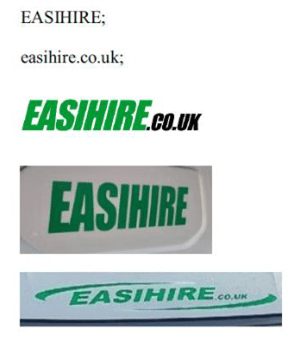
easyGroup Ltd owns a UK registered trade mark for easyHire logo (series of 2), registered since 2007, for vehicle rental and hire services (class 39). It brought an infringement claim (based on a likelihood of confusion) against Jaybank Leisure, a company that had been operating an online vehicle rental and sales business under the name EASIHIRE. Images of the mark registered by easyGroup and the sign used by Jaybank's are below.
 |
 |
Infringement
In its claim, easyGroup relied on the following class 39 terms only: ‘Rental and hire of… motorised vehicles, non-motorised vehicles…and means of transport; advisory and information services relating to the aforesaid services; information services relating to transportation services, including information services provided on-line from a computer database or the Internet’. It was largely agreed that the services provided by Jaybank were identical or very similar to those relied on by easyGroup.
The easyHire and EASIHIRE marks were found to be aurally and conceptually identical, sharing the common concept of "hiring made easy". Visually, the only differences between the marks were font, capitalisation, and the i/y distinction. The judge found that the average consumer would not attach significance to the i/y distinction, likely treating it as a typo, and would pay less attention than a brand expert to font and capitalisation choices.
Despite the fact that there was no evidence of actual confusion, considering all the factors, including the imperfect recollection of the average consumer, a likelihood of confusion was established. Jaybank's argument that EASYHIRE was purely descriptive was rejected, the judge finding the mark had the minimum degree of distinctiveness required to serve as a trade mark.
Subject to a valid defence, Jaybank's use of its sign therefore infringed the easyGroup's mark.
The non-use defence
Under s.11A, a defendant can defeat an infringement claim if the trade mark would be liable to revocation for non-use. easyGroup therefore had to show genuine use of its easyHire mark in relation to vehicle hire and rental services etc in the five years preceding the date the infringement action was brought - 23 April 2024.
easyGroup pointed to two websites to try to establish genuine use:
- easyHire.mobi: Operated by easyGroup itself, but launched only in January 2024 with no evidence of use before the critical date of 23 April 2024. It was disregarded entirely.
- easyHire.biz: Operated by an easyGroup licensee, easyHire Technologies Ltd. The website promoted the technology platform and franchise network operated by the licensee. The judge found that this use related to franchising and technology services rather than vehicle hire and rental services. easyGroup's argument that the mark functioned as an "umbrella" brand covering all services within its franchise network was rejected.
No adequate reasons for non-use in relation to the relevant services were provided by easyGroup, meaning that Jaybank's non-use defence succeeded and the infringement claim failed.
What does this mean for you?
- Use it or lose it. A mark that sits on the register for five years or more without genuine, market-facing use in relation to the registered goods or services is vulnerable to revocation and cannot be enforced.
- Use must match your specification. Use in a related but different area of commerce will not satisfy the genuine use requirement. Use for franchising and technology services was not use for vehicle hire and rental services.
- Watch your timing. Use that commences in the three months immediately before an application for revocation (or similar) is made is disregarded unless preparation for such use began before the proprietor became aware that the application might be made. Those who wish to question use of a mark should put the owner on notice of that fact at an early stage.
- Keep clear records. Solid, objective evidence of use that is dated is essential. Vague or undated evidence will not suffice.
Dans cette série
Brexit strikes again! Re-filed UK marks could now be refused/invalidated when they were not before…
23 mars 2026
UKIPO fee increases from 1 April 2026: how to save costs
23 mars 2026
Another lesson for descriptive brands: Athleta v Sports Group Denmark
23 mars 2026
A reminder of the use or lose it approach to trade marks: easyHire
23 mars 2026
A quick guide to… retrieving IP rights from dissolved companies in England and Wales
23 mars 2026
Can AI-generated product and other designs claim IP protection?
23 mars 2026

Related Insights

Does copyright subsist in AI-generated content?

Key UK ruling for producers of "free-from" products
