

2026年2月25日
Once again, no copyright protection for AI-generated output
High hurdles for copyright protection. The Munich Local Court dismissed a lawsuit based on alleged copyright infringement seeking an injunction against three AI-generated logos. The ruling thus joins the majority of case law that denies protection under copyright and patent law. This overview is relevant for anyone who generates or reuses AI-assisted output.
Key statements of the Munich Local Court in brief:
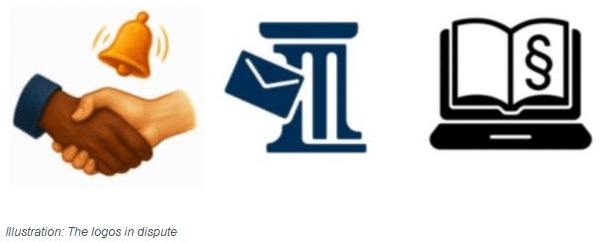
The subject of the proceedings were three logos that the plaintiff had created using generative AI and used online: a handshake with a bell, an envelope in front of columns, and a laptop with a floating book with a paragraph symbol. The court dismissed the action for injunctive relief and denied that any of the three designs were works of art. The decisive factor was that they lacked personal intellectual creativity:
- The concept of a work under copyright law always presupposes the intellectual act of creation by a human being.
- For the use of AI systems, this means that a dominant human influence must be verifiable.
- This requires AI to be used as a tool and not as a “creative instrument.”
- For the Local Court of Munich, the AI model was used as a creative tool in this case, regardless of the length and number of prompts. For this reason, copyright protection was denied in the ruling.
Essential: The concept of a work in copyright law
The linchpin is the concept of a work in copyright law (Section 2 (2) UrhG). Firstly, this concept requires that the object of protection be an original and thus the author's own intellectual creation. Secondly, classification as a work is reserved for elements that express such a creation. Originality requires that the work show the personal, free creative expression of the author.
When using artificial intelligence and “software” in general, this means:
- If AI/software takes over in crucial areas, there is a lack of personal and creative expression. Mere human-controlled selection or technical corrections are not enough.
- Prompting therefore requires creative abilities to be expressed independently. This necessitates free and creative decisions.
- Neither financial expenditure nor diligence nor subsequent minor “fine-tuning” justify copyright protection. Only the creative result is protected as a work, not investments, time spent, or diligence.
No protection means public domain – check trademark and design law!
As a result, the decision means that the logos are not protected by copyright. This makes the logos public domain from a copyright perspective. This means that, in principle, anyone can use the logos freely. However, restrictions may arise from trademark and design law. This is because distinctive character is sufficient for trademarks and registered designs, regardless of the creation process.
Classification of the decision: Similarly strict standards in other legal systems and in patent law
In the broader context, the Munich ruling is in line with the majority of case law in copyright and patent law:
- The Prague Municipal Court ruled back in 2023 that, according to Czech copyright law—which, like German copyright law, is governed by an EU copyright directive—only natural persons can be authors, and an image generated by AI from a general prompt does not qualify for copyright protection.
- A similar rationale can be found in patent law. Here, the Federal Court of Justice ruled in 2024, followed by the Swiss Federal Administrative Court in 2025, that only a natural person can be an inventor under patent law.
- One of the few courts to have granted copyright protection for software generated works in the EU is the Italian Supreme Court (Corte di Cassazione) in favor of the work “The scent of the Night.” The court found that the form of expression was not purely technical or arbitrary, but had individual characteristics and that essential design elements could be attributed to the author, although the work was created using a fractal generator algorithm. The 2025 Italian AI Law has since codified approach expressly for AI systems, requiring demonstrable human intellectual effort for copyright protection of AI-assisted works.
- In the US, too, the prevailing view seems to be that prompts are not sufficient. The most famous case here is probably “Zarya of the Dawn”, which went viral in February 2023. However, a supreme court ruling is still pending in the US as well.
- In China, however, the situation is unclear. On the one hand, prompts were considered sufficient for copyright protection in cases from 2023 and 2025, but not in another case from 2025. There is no decision from the Supreme People's Court (yet).
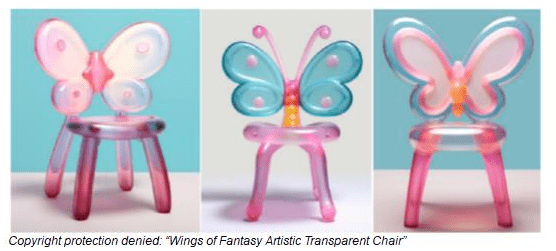
Conclusion
Copyright protection for AI-assisted content requires that AI be used solely as a subordinate tool in the creation of the output. For this reason, the everyday use of generative AI systems will generally not be protected by copyright. After all, the reason for their popularity is precisely that they can create any content “at the touch of a button.” Extended protection may be considered through trademark and design law. However, if AI systems are actually used as mere tools, specific prompts and instructions for action should be documented when working with AI-assisted tools.
FAQs
Q: Is AI-generated content protected by copyright in Germany?
A: Pure AI products without demonstrable creative human influence are not protected by copyright. AI must be used as a subordinate tool and not as a “creative instrument”.
Q: What options are available for protecting AI content?
A: Protection can primarily be achieved through trademark law and registered designs, as these focus on distinctiveness rather than the level of creativity. For texts, title protection under trademark law may also be considered.
Q: What needs to be documented in order to preserve copyright protection opportunities?
A: Every substantial creative human contribution should be documented in a comprehensible and verifiable manner, for example through process descriptions, interim results, and editing steps.
Q: Can public domain, AI-generated works be used by third parties without further ado?
A: Yes, if a work is in the public domain in terms of copyright—as is typically the case with AI-generated content—third parties can generally use it freely. However, restrictions may result from trademark, design, or other property rights.
Q: What role does the scope and complexity of the prompt play in copyright protection?
A: Extensive or complex prompts alone are not sufficient. The decisive factor is whether the creative expression ultimately originates from a human being. What matters is the human influence, not the length or depth of detail of the prompt.

Related Insights

EU Inc. – The 28th Regime: How the European Commission intends to revolutionise the formation of companies

Germany: four years of cancellation buttons – status quo and new developments

What international businesses should know about the German AI Market Surveillance and Innovation Promotion Act
作者